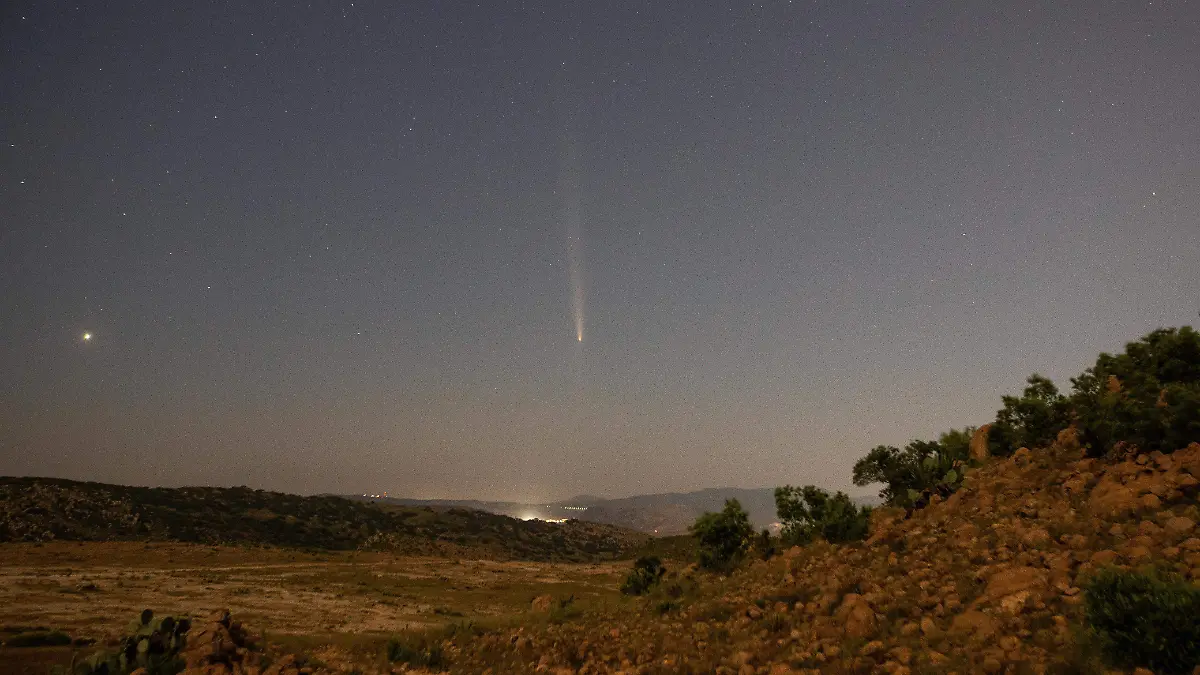
Every year, between August 12 and 15, the sky offers a unique natural spectacle: the Perseid meteor shower, considered by astronomers and amateurs to be the most impressive of the astronomical calendar. However, in San Luis Potosí, enjoying this phenomenon can become a challenge, not for lack of enthusiasm, but because of an old enemy of skywatchers: rain clouds.
First: What are the Perseid meteor showers?
“The Perseids are usually a spectacular event; but almost every year, in San Luis, the sky is cloudy due to seasonal rains,” explains Dr. Roberto Bartali Marchetti, professor at the Faculty of Sciences of the Autonomous University of San Luis Potosí (UASLP), and a specialist in astronomy and astrophysics.
Although the meteor shower has a peak of activity of just a few hours, its total duration extends over several days. The Perseids are known for their intense activity. Under ideal conditions, between 10 and 20 meteors can be observed per hour, and some “shooting stars” even shine brightly in the night sky.

Contrary to what their name suggests, meteor showers are not actual stars, but rather dust particles left behind by comets as they approach the Sun. These tiny particles travel at speeds of up to 70,000 kilometers per hour, and upon contact with Earth’s atmosphere, they are heated by friction, generating bright bursts that we can see from Earth.
“What we see as flashes in the sky is cosmic dust ignited by the heat as it enters the atmosphere. These are very small particles, but traveling at extremely high speeds,” Bartali explains.
The Perseids, in particular, originate from the comet Swift-Tuttle, which left a trail of debris in its orbit. Every year in August, Earth crosses that trail, and the sky is filled with light.
Why is it difficult to see the Perseids in San Luis Potosí?
The problem for sky lovers in San Luis Potosí is that August coincides with the peak of the rainy season. This means that, despite the event being visible to the naked eye and without the need for telescopes, many miss it.
“Here in San Luis, it’s almost always cloudy during those dates. Sometimes the weather works against us, but it’s worth a try.”
Where is the best place to see the Perseids in the state of San Luis Potosí?
Although there’s no guaranteed clear sky, Bartali recommends some spots in the state with better viewing conditions, such as municipalities in the Potosí highlands, especially due to their altitude and less light-polluted skies.
The central zone, particularly the entrance to the Huasteca, where relatively clear skies can still be found, although with a higher risk of humidity and cloudiness.
The key, says the expert, is to stay away from the city and sources of light pollution, and to be patient: “With good luck and a clear sky, we could see two or three very bright meteors every hour. But if there are clouds, we’ll have to wait until next year or look for another meteor shower.”
According to the specialist, there are more than 700 meteor showers each year, although only a dozen offer true spectacles visible to the naked eye. Some of the most notable are the Geminids, which appear in December, the Orionids in October, and the Leonids in November. But none are as eagerly awaited as the Perseids, which remain the jewel of the summer sky.
In the midst of daily routine, observing a meteor shower can be an experience of wonder, calm, and connection with the universe. Even if clouds frustrate your vision, simply stopping to look at the sky is valuable.
“The universe is in constant motion and always presents us with wonders. We just have to take the time to look up,” concludes Bartali Marchetti.
Source: oem